
Airborne UAV survey
(Service)
Online Support Service: No
Interpretation of Data: No
Description:
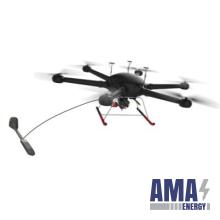
Performing large-scale low-altitude high-resolution magnetic surveys using unmanned aerial vehicles (UAVs). Geophysical technologies on UAVs in comparison with ground-based methods can increase the speed of research, especially in difficult-to-reach and remote areas from the infrastructure.
Overview:
To reduce deviation interference, the magnetometer sensor is placed in a suspended gondola. The complex includes satellite navigation equipment (GPS + GLONAS), providing coordinate reference of measurement points (antennas are located both on the UAV and in the gondola).
Special software allows you to prepare a detailed flight mission taking into account the digital terrain model, which can be obtained by photogrammetry (processing of images obtained using UAVs).
UAV Features:
- multi-rotor unmanned aerial vehicle with a hybrid engine;
- application in any landscape-morphological conditions;
- speed - up to 50 km / h;
- flight duration - up to 5 hours;
- temperature barrier: - 20 ° С + 40 ° С
The main tasks to be solved:
- identification of ore deposits with favorable magnetic differentiation of rocks;
- mapping of different ranking zones of discontinuous violations;
- isolation of intrusive complexes of various compositions;
- allocation of zones of metasomatically altered rocks;
- mapping of buried paleodolines in order to predict placer deposits.
The main parameters of the magnetometer:
- Type: quantum
- Sensitivity: 0.6 pT
- Measuring Range: 15,000 to 105,000 nT
- Measurement frequency: 1000 Hz
- Range of allowable sensor angles: 10 ° to 85 °
- Operating temperature range: from -20 to +40 ° С
- Heading error: ± 0.25 nT


Advantages of the method:
- high measurement density along the profile - the distance between the samples is about 1 m;
- high accuracy of binding of measurement points and measurements themselves;
- uniformity of coverage of the work site;
- shooting with detailed flow around the relief at the lowest possible height;
- the ability to perform multilevel measurements in order to reduce ambiguity in quantitative interpretation.


AO «GNPP« Aerogeophysics »
Locations: Russia Moscow
Main Products/Services: Integrated airborne geophysical surveys
Registration: Russia Moscow