
Universal unit for Hardening and Chemical-Thermal Treatment SNCA
(Equipment / Material)

Condition: New
Location or Storage Country: Russia
Service Engineering Support: Yes
Warranty: Yes
Price: Call for price
Description:
Universal automated chamber furnace-based heat treatment units are designed for metal parts using quenching with heating in a protective atmosphere, carburizing, nitrocarburizing, normalizing, annealing, washing and drying of parts before tempering, and high and low tempering. The unit automatically performs all stages of the quenching, carburizing, nitrocarburizing, annealing, normalizing, washing, tempering, and transfer of workpieces between the unit's components. The chamber furnace-based design allows for the creation of a highly flexible production system for the heat treatment section and enables high-quality heat treatment of both large-scale parts and individual items in a single production cycle, both in automatic or semiautomatic modes.
Overview:
The universal automated unit may include the following equipment:
- universal chamber furnace with gas or electric heating with integrated oil quenching;
- universal chamber electric furnace for low or high tempering;
- universal intermittent washing machine with electric heating;
- universal double-sided transfer trolley with intermittent action;
- universal stationary table for accumulating cages;
- universal stationary table with forced cooling of the charge;
- universal lifting table for preparing the cage;
- endogenerator;
- loading equipment;
- control system.
The composition of the equipment and its quantity are individually selected based on the production needs of the Buyer.
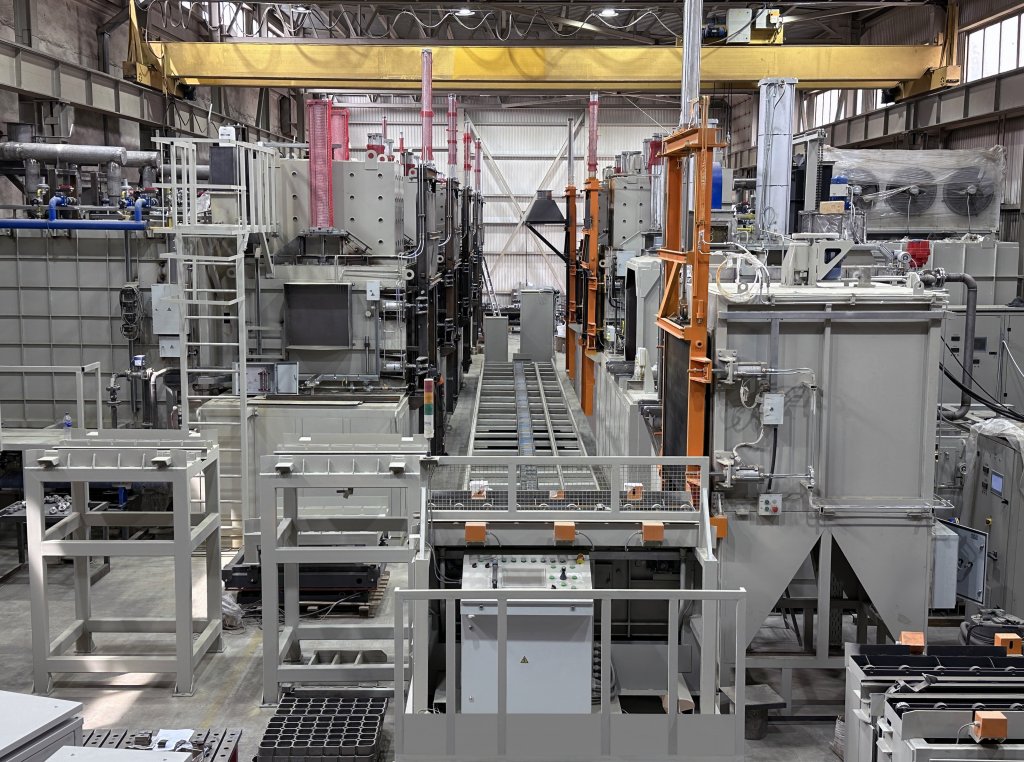
Universal oven
The furnace heating system is sufficient to provide optimal heating time for loaded cages to reach the furnace operating temperature.
The universal chamber furnace is a batch-type unit equipped with a roof fan, a heating system, an integrated quenching tank, and a pre-chamber. The furnace is designed for carburizing, hardening, normalizing, and annealing. Load transfer within the furnace is accomplished automatically using a system of loading mechanisms.
The furnace capacity is determined based on the maximum load, heating rate, and the ability to uniformly quench or atmospherically cool the charge.
The lined furnace body, together with the quenching tank and pre-chamber, form a gas-tight structure.
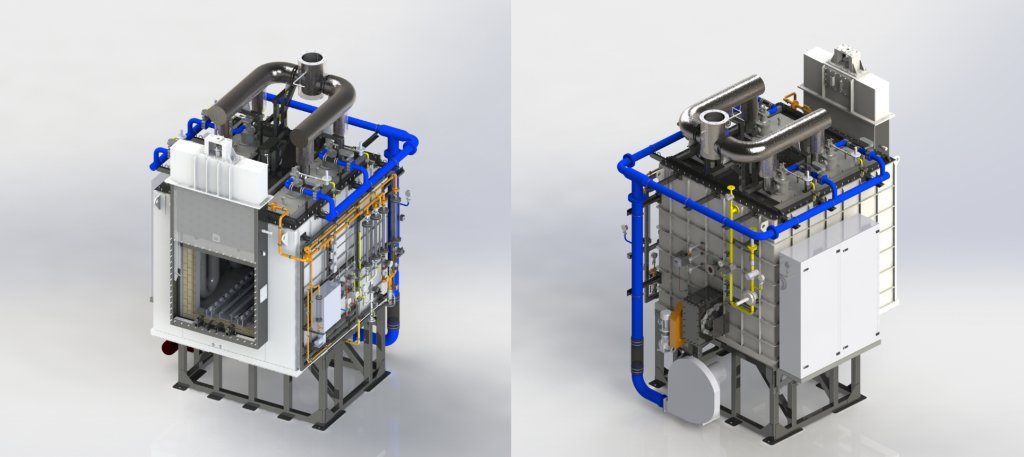
The universal oven is equipped with a ladder and service platforms on both sides and across the rear of the oven. This provides easy access to the heating system and maintenance of the roof fan.
The universal furnace's heating system consists of heat-resistant centrifugally cast pipes. The pipes can be heated by either block electric heaters or gas burners.
Uniform heating of the workpieces is achieved by ensuring a larger ratio of the working surface of the heating system to the surface of the chamber and ensuring an optimal gap between the workpiece and the furnace hearth.
Distribution of the atmosphere in the heating chamber is achieved by a specially designed atmosphere recirculation fan.
Atmospheric potential control is achieved through the use of an oxygen sensor manufactured using advanced technology in combination with specialized software control.
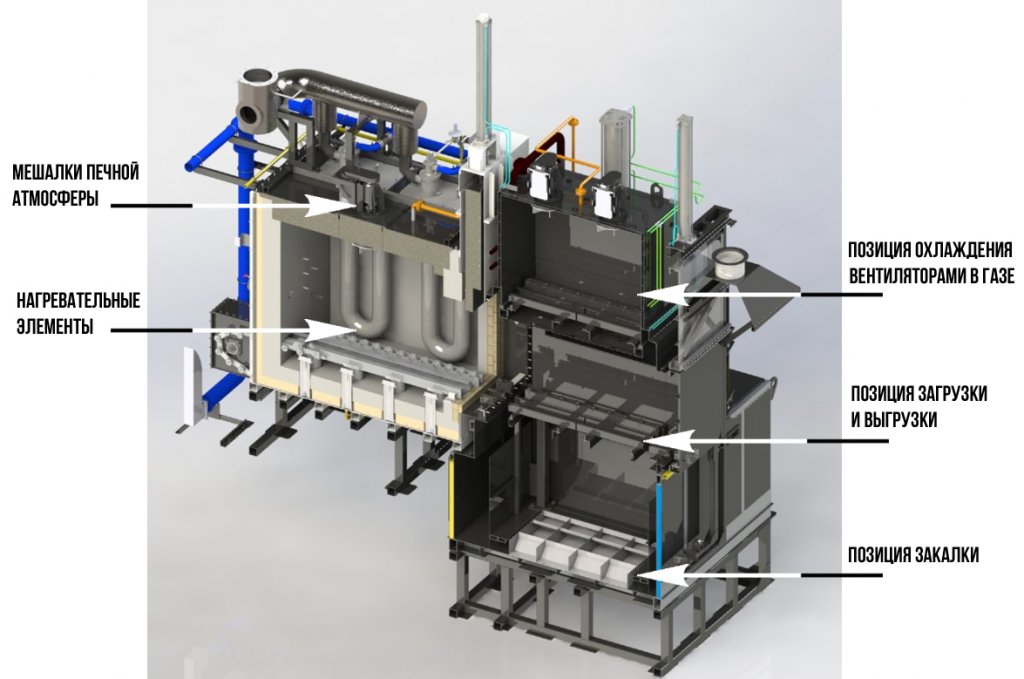
During cementation, constant quality is ensured by the following capabilities:
- Uniform heating of workpieces to the required temperature.
- Uniform distribution of the atmosphere so that the parts can be properly treated with the carburizing atmosphere.
- Precise control of carbon potential in the furnace chamber.
- Quenching of the charge with uniform cooling.
After uniform heating of the charge, the next important criterion is rapid and uniform hardening of the charge.
The hardening system is designed with the following features:
- The size of the quenching bath ensures a minimal instantaneous rise in the temperature of the quenching medium.
- The workpiece being processed is uniformly treated with a circulating quenching medium.
To ensure uniform circulation of the quenching fluid, the bath is equipped with stirrers. The flow from the stirrers is directed through a system of guides. The guide system is designed so that cooling occurs at a uniform rate throughout the charge area.
The quenching bath is equipped with systems for heating and cooling the quenching liquid based on a recirculation pump and an air-oil heat exchanger (dry cooling tower).
The prechamber is a device integrated with the quench tank and furnace into a single, sealed, gas-tight structure filled with a protective atmosphere that prevents oxidation and decarburization of the parts during their transfer from the furnace to the quench tank and the accelerated charge cooling chamber. The accelerated charge cooling chamber is located in the upper part of the prechamber.
The pre-chamber has two tiers (tier 1 is the furnace loading level, tier 2 is the accelerated cooling chamber itself). While one charge is being loaded, another can remain in the quench tank. The pre-chamber's upper section (in the accelerated cooling chamber) has two separate fans to ensure forced cooling of the charge. Loading between tiers is accomplished using a mechanized elevator.

The accelerated cooling chamber of the charge has double walls, creating an oil cooling system. Quenching oil from the quench tank is used to cool the walls. The oil is circulated by the oil cooling system pump.
The pre-chamber is equipped with a gas-tight door with a ceramic seal. The door is moved by a pneumatic cylinder. The door moves along vertical guides, ensuring a tight fit around the entire perimeter of the pre-chamber loading opening.
The pre-chamber loading opening is equipped with a flame curtain located at its bottom. This curtain serves to burn off the endothermic atmosphere escaping from the furnace and prevent atmospheric air from entering the pre-chamber and furnace chamber when the door damper is open. The flame curtain is equipped with a pilot burner, an ignition system, and a flame monitoring system. The flame curtain ignites automatically when the pre-chamber door is opened.
The control system of the universal unit is based on modern microprocessor technology (PLC and temperature controllers).
Control system
Each unit of the unit: the universal and tempering furnaces, the transfer cart, and the washing machine are equipped with their own programmable logic controllers and touch-screen operator panels.
The control system has a hierarchical structure. Local control system controllers are networked and report to the complex controller.
The integrator of the equipment operation in the line is the transport manipulator (transfer trolley), which ensures the transfer of loads (products) between individual units of the line.
The unit is designed to operate in the following modes: automatic (according to a pre-set program), semi-automatic and manual (adjustment).
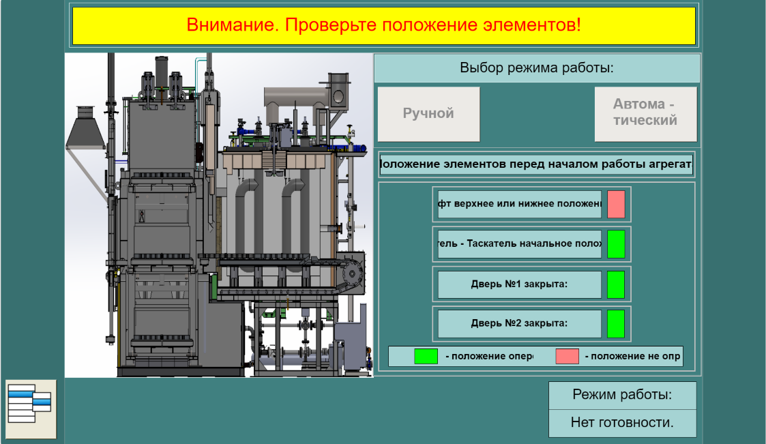
The control system provides:
- Review and adjustment of work programs (not affecting safety);
- Control of the temperature regime of equipment according to a given algorithm;
- Management of carbon potential inside carburizing-hardening machines according to a given algorithm;
- Control of movement of the cage within the complex;
- Monitoring of emergency situations (burner malfunction, excess temperature);
- Self-testing (malfunction and failure of measuring instruments, etc.);
- Real-time visualization of information about the progress of the process, its collection and archiving;
- Changing process parameter values.
The operator panel provides:
- Real-time display of data from temperature control devices for each equipment zone within the complex;
- Real-time display of data from carbon potential control devices for each furnace;
- Displaying the status of discrete devices;
- Possibility to start the process;
- Display of temperature graphs for all oven zones in real time;
- Display of carbon potential graphs in the furnace in real time;
- Display of pressure in the interior of the furnace;
- Possibility to start/stop the process.
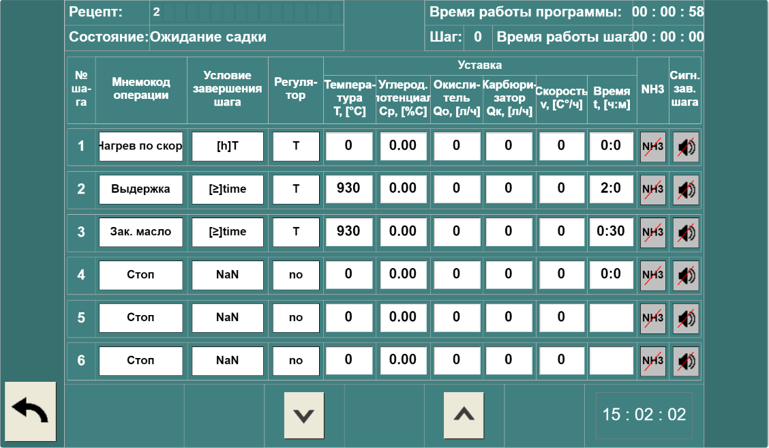
The equipment is designed to provide a long service life, however, when maintenance and repairs are required, all components are mounted in blocks so they can be removed and easily replaced without costly downtime.
The fan, mounted as a block under the dome, is cast from a heat-resistant alloy to ensure a long service life. All other components, such as roller guides, pusher heads, drive systems, etc., are designed with a high degree of reliability to ensure trouble-free operation and a long service life. The equipment is fully equipped with service platforms for easy access.
The universal unit is designed to be installed inline, or any of its components can be mounted on either side of the transfer cart. All maintenance and repair work can be performed remotely from the sides, eliminating the need for expensive space behind the equipment.


It is possible to manufacture with both gas heating and electric heating.
| Name | Working space size (L-W-H), mm | Weight of the cage, kg |
|---|---|---|
| СНСА 6.9.6 | 910-610-610 | 600 |
| СНСА 9.12.9 | 1220-915-915 | 1500 |
| СНСА 9.15.9 | 1550-915-915 | 1650 |

JSC "Nakal" - Industrial Furnaces
Total Employees: 56
Locations: 141503, Russia, Moscow region, Solnechnogorsk, Revolution Street, Building 3, Office 82
Main Products/Services: Electric and gas-fired furnaces for heat treatment of metals, automated quenching, tempering, and chemical treatment units, pusher-type continuous furnaces, bogie-hearth furnaces, endothermic generators, quenching tanks, and washing equipment. Services: custom development, commissioning, maintenance, and automation.
Registration: 141503, Russia, Moscow region, Solnechnogorsk, Revolution Street, Building 3, Office 82
Year Established: 2008