
ORC System (e.g., Representative 19 MW waste heat Recovery unit)
(设备/材料)

状态: New
位置或存放国家: Italy
服务工程支持: Yes
保证: No
价钱: 要求价格
描述:
Turboden ORC systems use a closed Organic Rankine Cycle to generate electricity and heat from various thermal sources including waste heat, biomass, and geothermal. The technology is suitable for distributed generation with sizes up to 40 MW per single shaft. Systems feature high availability, low maintenance, and operation without water/steam.
概观:
- Power range: from hundreds of kW up to 40 MW per single shaft
- High efficiency at partial loads (e.g., 90% of nominal at 50% load)
- Operating temperatures: up to >300°C (standard), higher in specific applications
- Availability: 98%+
FEATURES
The ORC unit is a system based on a closed-loop thermodynamic cycle for the generation of electric and thermal power, especially suitable for distributed generation. In this section the key points of ORC technology compared to steam technology are explained.
FLEXIBILITY
- Large range of sizes from small to medium sizes (up to 40 MW per single shaft)
- Different primary energy sources, from renewable energy (geothermal, solar, biomass) to energy efficiency (i.e. waste heat from industrial processes) to conventional fuels (natural gas, flare gas)
- Different kind of heat carrier fluids: intermediate fluid (thermal oil, saturated steam, water) or directly from industrial smoke through a direct exchange
- Large rangeability: different temperatures of the source (even below 100°C through selection of proper working fluid); partial load (the ORC system keeps high electrical efficiency even when operating with lower thermal power input, even 10% of the nominal one)
* The efficiency of the ORC system is always optimized: on average at 50% load, electrical efficiency is still 90% of the nominal electrical efficiency.
- Cogeneration mode or power-only mode. In cogeneration, the thermal output can be hot water or steam
- Ease of integration into pre-existing systems (i.e. in waste heat recovery from industrial processes)
- Island mode capability
EASY TECHNOLOGY
- Simple technical features: low pressures involved, low speed turbine, limited number of stages of the turbine (≤6), self-lubricating fluids, no water required
- Easy and cost-effective operation & maintenance: automatic operation (no qualified operator required), minimal maintenance activities, no major overhaul (turbine not subject to erosion and corrosion), fast start-stop procedures, no chemical and water treatments, low refiling of fluid required
- Possibility to install the ORC unit in remote places, working efficiently
RELIABILITY
- High availability (98% +)
- Long life
SUSTAINABILITY
- Core system for renewable energy and energy efficiency
- Clean generation of power and heat
- Reduction of CO2 emissions (e.g. in heat recovery or in geothermal where the ORC system operates with zero emissions thanks to the reinjection)
THE RANKINE CYCLE
The Rankine Cycle is a thermodynamic cycle that converts heat into work. The heat is supplied to a closed loop, which typically uses water as working fluid. The Rankine Cycle based on water provides approximately 85% of worldwide electricity production.
The Organic Rankine Cycle's principle is based on a turbogenerator working as a conventional steam turbine to transform thermal energy into mechanical energy and finally into electric energy through an electrical generator. Instead of generating steam from water, the ORC system vaporizes an organic fluid, characterized by a molecular mass higher than that of water, which leads to a slower rotation of the turbine, lower pressures and no erosion of the metal parts and blades.
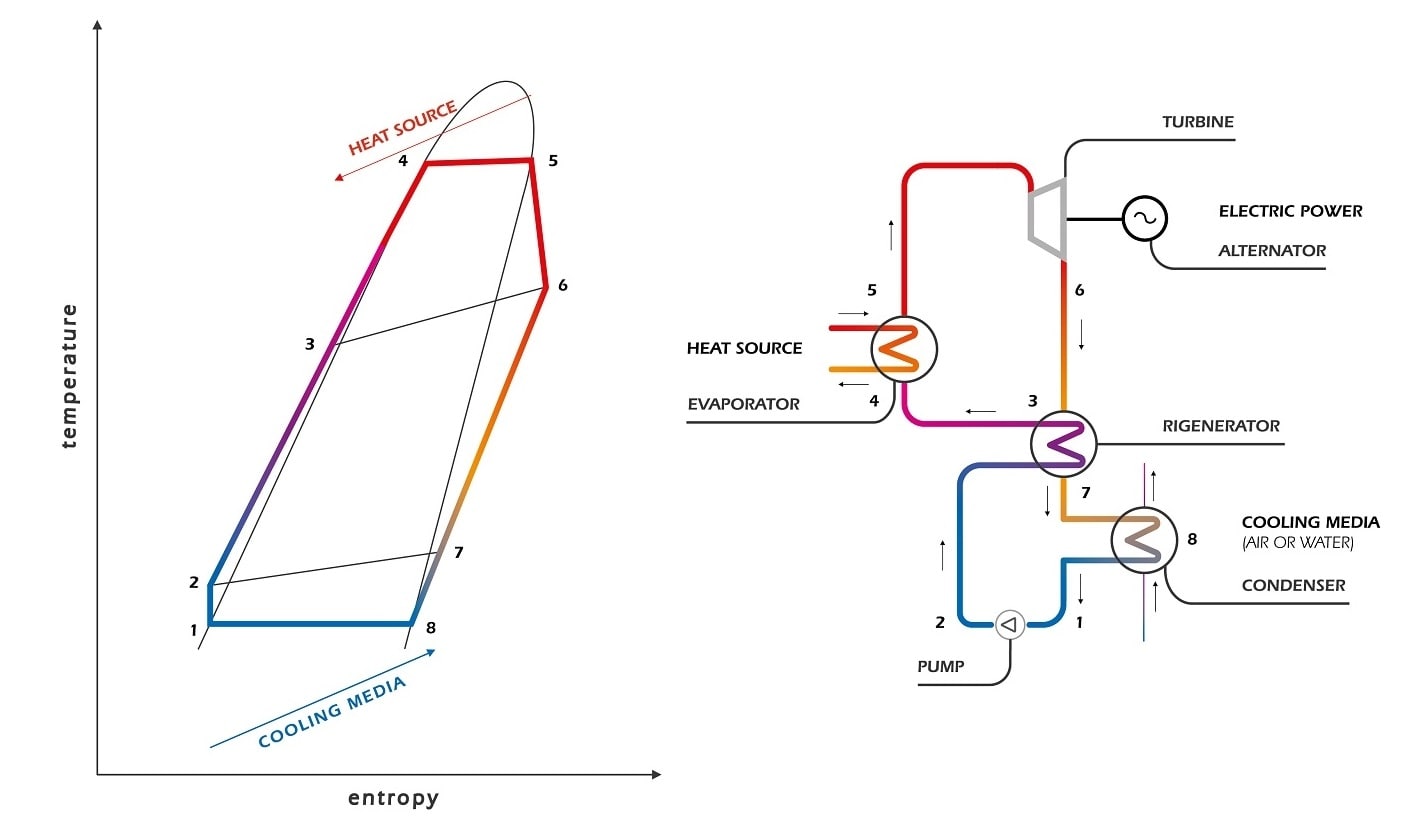
The ORC turbogenerator uses medium-to-high-temperature thermal oil to preheat and vaporize a suitable organic working fluid in the evaporator (4>5). The organic fluid vapor rotates the turbine (5>6), which is directly coupled to the electric generator, resulting in clean, reliable electric power.
The exhaust vapor flows through the regenerator (6>7), where it heats the organic liquid (2>3) and is then condensed in the condenser and cooled by the cooling circuit (7>8>1). The organic working fluid is then pumped (1>2) into the regenerator and evaporator, thus completing the closed-cycle operation.
Turboden S.p.A.
地点: Via Cernaia, 10 25124 Brescia - Italy
主要产品/服务: Organic Rankine Cycle (ORC) systems; Large Heat Pumps; Gas Expanders; Engineering, integration, after-sales service, maintenance
注册: Via Cernaia, 10 25124 Brescia - Italy
成立年: 1980